A White Rose at Midnight
- Description
- Praise
- About the Playwright
-
Take a look inside | Get the E-book
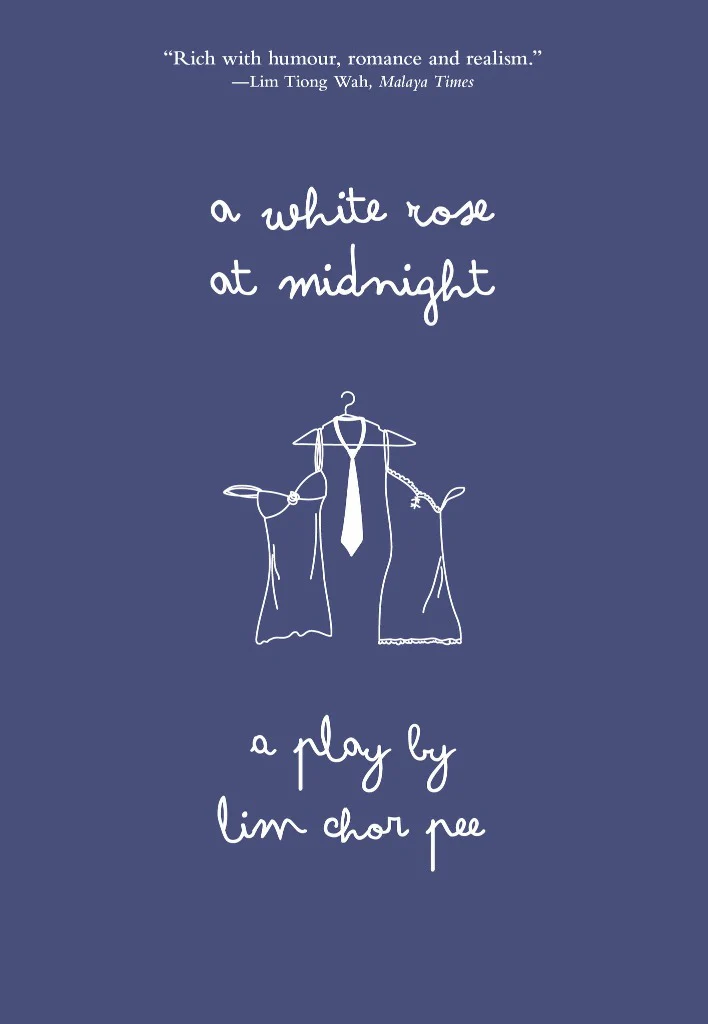
On the cusp of independence, cultures collide in a bedroom in Singapore. As the Vietnam War rages on, the English-educated scholar Lee Hua Min—“the finest product of the University”—finds himself hopelessly disillusioned. Enter Wong Ching Mei, a Chinese-educated former nightclub singer seeking to enrol in Nanyang University. Mirroring the intense tussles between the English- and Chinese-speaking during Singapore’s formative years, Hua Min and Ching Mei trade ferocious barbs even as they are inexplicably drawn to each other. When Su-Ling, Hua Min’s ex-classmate, returns from London, Hua Min is torn between their advances and the extremely different worlds they inhabit. Humorous, witty and prescient, A White Rose At Midnight is a pithy portrait of a soul—and nation—divided.
A White Rose At Midnight was first staged to critical acclaim by the Experimental Theatre Club in 1964. It was pioneer playwright Lim Chor Pee’s second and final play after the landmark Mimi Fan (1962). In 2014, Centre 42 mounted a partial dramatised reading of the play.
-
“Full of wit and humour... Though the humour is unending this play has a serious theme — the search for identity by the present day generation.”
—The Straits Times“[Lim Chor Pee has] a mind that has something original to say to an audience which is sympathetic to the growth of Malayan theatre.”
—The Straits Times -
Lim Chor Pee was a pioneer Singapore playwright writing in English in the early 1960s, part of a circle of writers and theatre practitioners finding their voice as Singapore gained independence.
Born in Penang in 1936, he attended the Penang Free School and in 1955, he set sail for England where he read law at St. John's College, Cambridge University. Upon graduation in 1958, he moved to London to sit for the English Bar exams. He came to Singapore in 1959 joining the Singapore Legal Service and later established himself in private practice where he spent the rest of his career.
He was the founder president of the Experimental Theatre Club (ETC), which, together with like-minded friends, he set up in 1961 to foster the growth of English language Malayan theatre in a time when the local theatre scene was dominated by expatriates and Western plays. As well as producing plays for ETC, he began to write. The following year his first play Mimi Fan was staged by ETC at the Drama Centre at Fort Canning. His second play A White Rose at Midnight was staged in 1964.
He contributed articles on the development of local theatre to Tumasek, a literary journal, for which he also served as a member of its editorial advisory board. Started by poet and novelist, Dr. Goh Poh Seng in 1964, Tumasek aimed to provide a platform to nurture local writers and counted Edwin Thumboo and Robert Yeo among its contributors.
Lim practised law for over 40 years until he passed away in December 2006, leaving behind his Swiss-born wife, three children and three grandchildren.
Original: $16.90
-65%$16.90
$5.91Product Information
Product Information
Shipping & Returns
Shipping & Returns
Description
- Description
- Praise
- About the Playwright
-
Take a look inside | Get the E-book
On the cusp of independence, cultures collide in a bedroom in Singapore. As the Vietnam War rages on, the English-educated scholar Lee Hua Min—“the finest product of the University”—finds himself hopelessly disillusioned. Enter Wong Ching Mei, a Chinese-educated former nightclub singer seeking to enrol in Nanyang University. Mirroring the intense tussles between the English- and Chinese-speaking during Singapore’s formative years, Hua Min and Ching Mei trade ferocious barbs even as they are inexplicably drawn to each other. When Su-Ling, Hua Min’s ex-classmate, returns from London, Hua Min is torn between their advances and the extremely different worlds they inhabit. Humorous, witty and prescient, A White Rose At Midnight is a pithy portrait of a soul—and nation—divided.
A White Rose At Midnight was first staged to critical acclaim by the Experimental Theatre Club in 1964. It was pioneer playwright Lim Chor Pee’s second and final play after the landmark Mimi Fan (1962). In 2014, Centre 42 mounted a partial dramatised reading of the play.
-
“Full of wit and humour... Though the humour is unending this play has a serious theme — the search for identity by the present day generation.”
—The Straits Times“[Lim Chor Pee has] a mind that has something original to say to an audience which is sympathetic to the growth of Malayan theatre.”
—The Straits Times -
Lim Chor Pee was a pioneer Singapore playwright writing in English in the early 1960s, part of a circle of writers and theatre practitioners finding their voice as Singapore gained independence.
Born in Penang in 1936, he attended the Penang Free School and in 1955, he set sail for England where he read law at St. John's College, Cambridge University. Upon graduation in 1958, he moved to London to sit for the English Bar exams. He came to Singapore in 1959 joining the Singapore Legal Service and later established himself in private practice where he spent the rest of his career.
He was the founder president of the Experimental Theatre Club (ETC), which, together with like-minded friends, he set up in 1961 to foster the growth of English language Malayan theatre in a time when the local theatre scene was dominated by expatriates and Western plays. As well as producing plays for ETC, he began to write. The following year his first play Mimi Fan was staged by ETC at the Drama Centre at Fort Canning. His second play A White Rose at Midnight was staged in 1964.
He contributed articles on the development of local theatre to Tumasek, a literary journal, for which he also served as a member of its editorial advisory board. Started by poet and novelist, Dr. Goh Poh Seng in 1964, Tumasek aimed to provide a platform to nurture local writers and counted Edwin Thumboo and Robert Yeo among its contributors.
Lim practised law for over 40 years until he passed away in December 2006, leaving behind his Swiss-born wife, three children and three grandchildren.