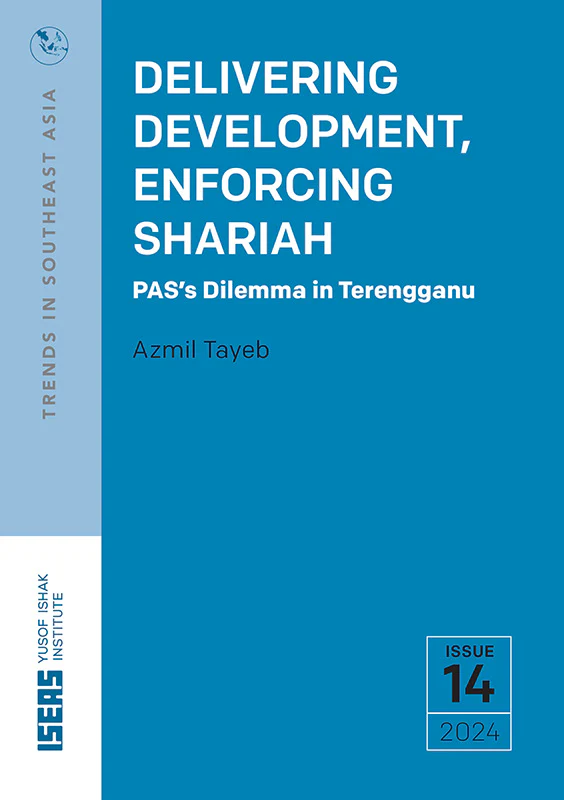
Delivering Development, Enforcing Shariah: PAS’s Dilemma in Terengganu
- Description
- About the Author
-
Whenever the Islamist party PAS comes to power in Terengganu, its political agenda has been to combine populist-type development programmes with the wish to turn Terengganu into a shariah-compliant state.
Terengganu’s state budget is however heavily dependent on the federal government, to the tune of 80–90 per cent. This hinders the state government’s policymaking and implementation, especially when the federal government is controlled by its political opponents.
This article argues that the politics of development play a more central role in determining the durability of the PAS state government in Terengganu than it does in neighbouring Kelantan. In other words, PAS cannot simply carry out its Islamic agenda without being complemented by tangible economic progress if it aspires to govern beyond a single term; PAS’s loss in the 2004 election after being in power for one term is a prime example of this dynamic.
One reason that the current PAS state government managed to get re-elected in 2022 was the unimpeded flow of oil royalty payments into state coffers since 2018, which allowed the state government to fulfil its campaign promises; PAS’s inclusion in the Perikatan Nasional federal government in 2020 further improved the state government’s financial standing.
When the reins of the federal government changed hands to PAS’s political opponents in 2022, the oil royalty payment to Terengganu again became an acrimonious issue, in many ways reprising the post-1999 situation.
The key for the PAS state government to rule beyond the current term is its ability to negotiate the tense federal-state relationship, develop other sources of revenue, and find ways to claim credit for economic progress, in addition to burnishing its Islamic governing credentials by making Terengganu a shariah-compliant state.
-
Azmil Tayeb is Associate Professor of Political Science at Universiti Sains Malaysia, Penang and former Visiting Research Fellow at the ISEAS – Yusof Ishak Institute, Singapore.
Original: $9.00
-65%$9.00
$3.15Product Information
Product Information
Shipping & Returns
Shipping & Returns
Description
- Description
- About the Author
-
Whenever the Islamist party PAS comes to power in Terengganu, its political agenda has been to combine populist-type development programmes with the wish to turn Terengganu into a shariah-compliant state.
Terengganu’s state budget is however heavily dependent on the federal government, to the tune of 80–90 per cent. This hinders the state government’s policymaking and implementation, especially when the federal government is controlled by its political opponents.
This article argues that the politics of development play a more central role in determining the durability of the PAS state government in Terengganu than it does in neighbouring Kelantan. In other words, PAS cannot simply carry out its Islamic agenda without being complemented by tangible economic progress if it aspires to govern beyond a single term; PAS’s loss in the 2004 election after being in power for one term is a prime example of this dynamic.
One reason that the current PAS state government managed to get re-elected in 2022 was the unimpeded flow of oil royalty payments into state coffers since 2018, which allowed the state government to fulfil its campaign promises; PAS’s inclusion in the Perikatan Nasional federal government in 2020 further improved the state government’s financial standing.
When the reins of the federal government changed hands to PAS’s political opponents in 2022, the oil royalty payment to Terengganu again became an acrimonious issue, in many ways reprising the post-1999 situation.
The key for the PAS state government to rule beyond the current term is its ability to negotiate the tense federal-state relationship, develop other sources of revenue, and find ways to claim credit for economic progress, in addition to burnishing its Islamic governing credentials by making Terengganu a shariah-compliant state.
-
Azmil Tayeb is Associate Professor of Political Science at Universiti Sains Malaysia, Penang and former Visiting Research Fellow at the ISEAS – Yusof Ishak Institute, Singapore.