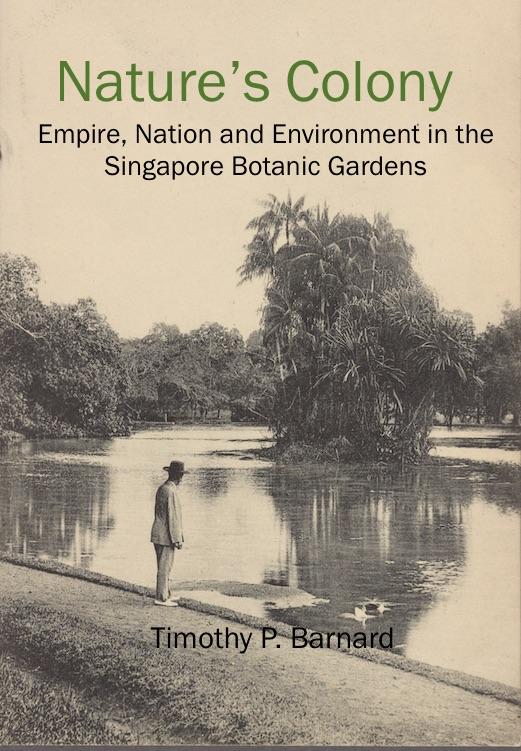
Nature's Colony
- Description
- Praise
- About the Author
-
Established in 1859, Singapore’s Botanic Gardens has been important as a park for Singaporeans and visitors, a scientific institution, and as an economic testing ground and launchpad for tropical plantation agriculture around the world.
Initially conceived to exploit nature for the benefit of empire, the Gardens were part of a symbolic struggle by administrators, scientists, and gardeners to assert dominance within Southeast Asia’s tropical landscape, reflecting shifting understandings of power, science and nature among local administrators and distant mentors in Britain. With the independence of Singapore, the Gardens has had to find a new role, first in the “greening” of post-independence Singapore, and now as Singapore's first World Heritage Site.
Setting the Singapore gardens alongside the Royal Botanic Gardens, Kew and botanic gardens in India, Ceylon, Mauritius and the West Indies, this book tells the story of nature’s colony — a place where plants were collected, classified and cultivated to change our understanding of the region and world.
-
“Nature’s Colony is a fascinating exploration of Singapore’s long-established botanical garden. For visitors since colonial times, the Garden has been a tranquil window into Southeast Asia’s biodiversity. The book conjures up both the changing romantic visions and the scientific imperatives that inspired the Garden’s curators. The book also takes us behind the fringe of leaves into scientific politics and the politics of Singapore society during its many transformations. Genially written and rich in anecdote, this book will enchant both historians and general readers.” - Robert Cribb, Professor of Asian History, School of Culture History and Language, Australian National University
-
Timothy P. Barnard is associate professor in the Department of History at the National University of Singapore. He is the editor of Nature Contained: Environmental Histories of Singapore and Contesting Malayness: Malay Identity Across Boundaries, also published by NUS Press.
Product Information
Product Information
Shipping & Returns
Shipping & Returns
Description
- Description
- Praise
- About the Author
-
Established in 1859, Singapore’s Botanic Gardens has been important as a park for Singaporeans and visitors, a scientific institution, and as an economic testing ground and launchpad for tropical plantation agriculture around the world.
Initially conceived to exploit nature for the benefit of empire, the Gardens were part of a symbolic struggle by administrators, scientists, and gardeners to assert dominance within Southeast Asia’s tropical landscape, reflecting shifting understandings of power, science and nature among local administrators and distant mentors in Britain. With the independence of Singapore, the Gardens has had to find a new role, first in the “greening” of post-independence Singapore, and now as Singapore's first World Heritage Site.
Setting the Singapore gardens alongside the Royal Botanic Gardens, Kew and botanic gardens in India, Ceylon, Mauritius and the West Indies, this book tells the story of nature’s colony — a place where plants were collected, classified and cultivated to change our understanding of the region and world.
-
“Nature’s Colony is a fascinating exploration of Singapore’s long-established botanical garden. For visitors since colonial times, the Garden has been a tranquil window into Southeast Asia’s biodiversity. The book conjures up both the changing romantic visions and the scientific imperatives that inspired the Garden’s curators. The book also takes us behind the fringe of leaves into scientific politics and the politics of Singapore society during its many transformations. Genially written and rich in anecdote, this book will enchant both historians and general readers.” - Robert Cribb, Professor of Asian History, School of Culture History and Language, Australian National University
-
Timothy P. Barnard is associate professor in the Department of History at the National University of Singapore. He is the editor of Nature Contained: Environmental Histories of Singapore and Contesting Malayness: Malay Identity Across Boundaries, also published by NUS Press.