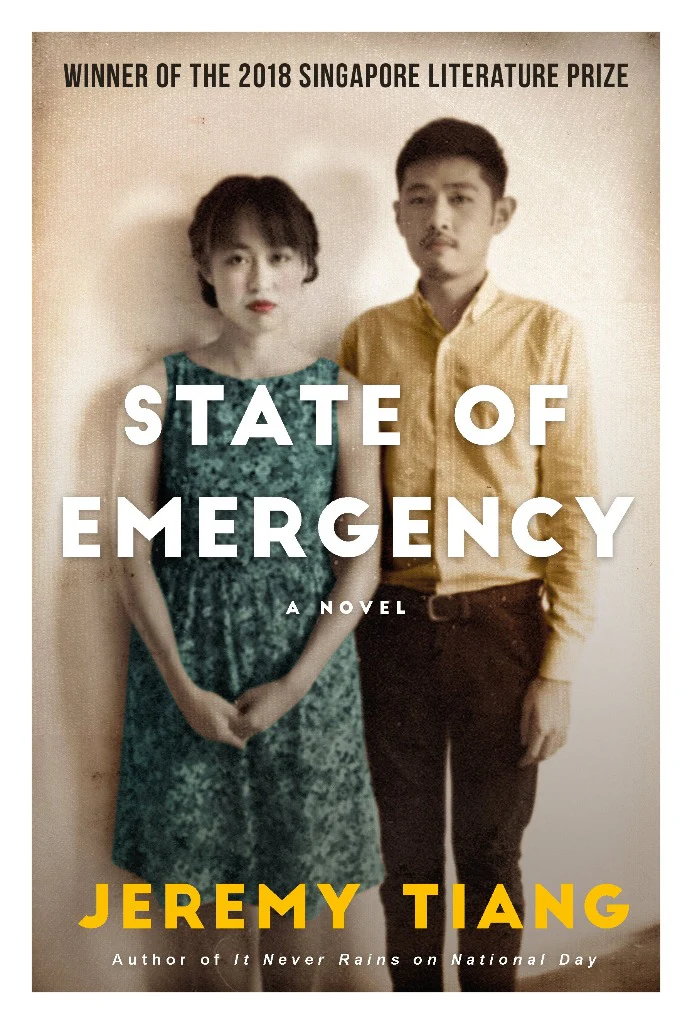
State of Emergency
- Description
- Praise
- About the Author
-
Shortlisted for NUS Singapore History Prize 2021
Winner of Singapore Literature Prize 2018, Fiction
Shortlisted for Singapore Book Awards 2018, Best Fiction Title
Finalist for the Epigram Books Fiction Prize 2016Look inside the book | Listen to the audiobook
Siew Li leaves her husband and children in Tiong Bahru to fight for freedom in the jungles of Malaya. Decades later, a Malaysian journalist returns to her homeland to uncover the truth of a massacre committed during the Emergency. And in Singapore, Siew Li's niece Stella finds herself accused of being a Marxist conspirator.
Jeremy Tiang's debut novel dives into the tumultuous days of leftist movements and political detentions in Singapore and Malaysia. It follows an extended family from the 1940s to the present day as they navigate the choppy political currents of the region. What happens when the things that divide us also bind us together?
-
“Masterfully written. Tiang has that rare talent for capturing some of the more unpleasant, eminently relatable aspects of Singapore society—from pious bureaucrats to sadistic authority figures—without cloying his art with sentimentalism or bitterness. State of Emergency is a compelling, important piece of work from one of Singapore's finest living authors.”
—The Straits Times
“Each of State of Emergency’s six sections, focusing on one character and period at a time, is gripping and powerfully emotive. All Tiang’s characters are well-realised, vulnerable, conflicted and forced to bear the burden of guilt for things which are beyond their control. The scars left on the extended Low family, split apart in so many ways and denied the chance to live normally together, mirror the scars etched deeply into a nation.”
—The Herald (Scotland)“Informed by years of painstaking research and brought to life with naturalistic, context-sensitive dialogue, Tiang’s characters speak not only with the authority, but also the tenderness, of truth. State of Emergency speaks as much to a world rocked by division and inequality as a country grappling with its own biography. It persuades us that there is always another layer to the truth, that one’s security and prosperity is ever, for another, a perpetual and bruising state of emergency.”
—Asian Review of Books“State of Emergency boldly takes on periods in Singapore’s history that many people would prefer not to face. To what degree citizens are culpable in what they have done and what they have failed to do at the worst moments of their nation’s history: this is the vital and uneasy question the novel impresses upon its readers.”
—Singapore Unbound
“Epic in scope, yet so intimate in its depiction of the characters. Tiang is a brilliant writer.”
—Kenny Chan, Chief Judge, SLP 2018 (English Fiction)
“A superbly structured piece of work. The sweep of the dramatic narrative is impressive, with just the right dose of intrigue and mystery.”
—Haresh Sharma, Resident Playwright, The Necessary Stage
“A well-written novel, and it has a wide historical perspective.”
—Philip Holden, author of Heaven Has Eyes and NUS Professor of English -
Jeremy Tiang’s writing has appeared in The Guardian, Esquire (Singapore), Brooklyn Rail, Drunken Boat, Meanjin, Ambit, Quarterly Literary Review Singapore and the first two volumes of The Epigram Book of Best New Singaporean Short Stories.
He won the Golden Point Award in 2009 and has been shortlisted for the Iowa Review Award and American Short Fiction Prize. He has also translated more than ten books from the Chinese, including work by You Jin, Wong Yoon Wah, Yeng Pway Ngon, Yan Geling and Zhang Yueran, and has been awarded translation grants from PEN American Center, the National Endowment for the Arts (US) and the National Museum of Taiwanese Literature. Jeremy’s plays include The Last Days of Limehouse (Yellow Earth, London), Floating Bones (The Arts House; translations of Han Lao Da and Quah Sy Ren one-acts) and A Dream of Red Pavilions (Pan Asian Rep, NYC; adapted from the novel by Cao Xueqin).
He lives in New York City.
Product Information
Product Information
Shipping & Returns
Shipping & Returns
Description
- Description
- Praise
- About the Author
-
Shortlisted for NUS Singapore History Prize 2021
Winner of Singapore Literature Prize 2018, Fiction
Shortlisted for Singapore Book Awards 2018, Best Fiction Title
Finalist for the Epigram Books Fiction Prize 2016Look inside the book | Listen to the audiobook
Siew Li leaves her husband and children in Tiong Bahru to fight for freedom in the jungles of Malaya. Decades later, a Malaysian journalist returns to her homeland to uncover the truth of a massacre committed during the Emergency. And in Singapore, Siew Li's niece Stella finds herself accused of being a Marxist conspirator.
Jeremy Tiang's debut novel dives into the tumultuous days of leftist movements and political detentions in Singapore and Malaysia. It follows an extended family from the 1940s to the present day as they navigate the choppy political currents of the region. What happens when the things that divide us also bind us together?
-
“Masterfully written. Tiang has that rare talent for capturing some of the more unpleasant, eminently relatable aspects of Singapore society—from pious bureaucrats to sadistic authority figures—without cloying his art with sentimentalism or bitterness. State of Emergency is a compelling, important piece of work from one of Singapore's finest living authors.”
—The Straits Times
“Each of State of Emergency’s six sections, focusing on one character and period at a time, is gripping and powerfully emotive. All Tiang’s characters are well-realised, vulnerable, conflicted and forced to bear the burden of guilt for things which are beyond their control. The scars left on the extended Low family, split apart in so many ways and denied the chance to live normally together, mirror the scars etched deeply into a nation.”
—The Herald (Scotland)“Informed by years of painstaking research and brought to life with naturalistic, context-sensitive dialogue, Tiang’s characters speak not only with the authority, but also the tenderness, of truth. State of Emergency speaks as much to a world rocked by division and inequality as a country grappling with its own biography. It persuades us that there is always another layer to the truth, that one’s security and prosperity is ever, for another, a perpetual and bruising state of emergency.”
—Asian Review of Books“State of Emergency boldly takes on periods in Singapore’s history that many people would prefer not to face. To what degree citizens are culpable in what they have done and what they have failed to do at the worst moments of their nation’s history: this is the vital and uneasy question the novel impresses upon its readers.”
—Singapore Unbound
“Epic in scope, yet so intimate in its depiction of the characters. Tiang is a brilliant writer.”
—Kenny Chan, Chief Judge, SLP 2018 (English Fiction)
“A superbly structured piece of work. The sweep of the dramatic narrative is impressive, with just the right dose of intrigue and mystery.”
—Haresh Sharma, Resident Playwright, The Necessary Stage
“A well-written novel, and it has a wide historical perspective.”
—Philip Holden, author of Heaven Has Eyes and NUS Professor of English -
Jeremy Tiang’s writing has appeared in The Guardian, Esquire (Singapore), Brooklyn Rail, Drunken Boat, Meanjin, Ambit, Quarterly Literary Review Singapore and the first two volumes of The Epigram Book of Best New Singaporean Short Stories.
He won the Golden Point Award in 2009 and has been shortlisted for the Iowa Review Award and American Short Fiction Prize. He has also translated more than ten books from the Chinese, including work by You Jin, Wong Yoon Wah, Yeng Pway Ngon, Yan Geling and Zhang Yueran, and has been awarded translation grants from PEN American Center, the National Endowment for the Arts (US) and the National Museum of Taiwanese Literature. Jeremy’s plays include The Last Days of Limehouse (Yellow Earth, London), Floating Bones (The Arts House; translations of Han Lao Da and Quah Sy Ren one-acts) and A Dream of Red Pavilions (Pan Asian Rep, NYC; adapted from the novel by Cao Xueqin).
He lives in New York City.