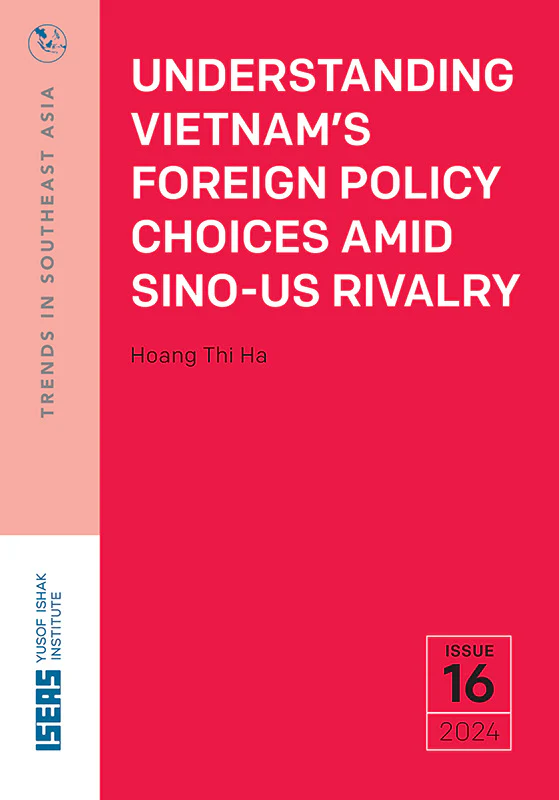
Understanding Vietnam’s Foreign Policy Choices Amid Sino-US Rivalry
- Description
- About the Author
-
Vietnam’s foreign policy towards China and the United States (US) involves a delicate process of reconciling and balancing competing perceptions, goals and interests within the country. This leads to foreign policy decisions that may respectively lean towards either China or the US, depending on specific circumstances and issues, while trying to maintain an overall equilibrium between the two powers.
Vietnam’s foreign policy adopts the paradigm of “cooperation” and “struggle” in its relations with major powers, and defines “national security” as encompassing both national sovereignty and regime security.
Given the common ideology and imperative of preserving political control of their respective communist parties, China may be a critical partner for Vietnam in terms of regime security but is often an “object of struggle” on national sovereignty. On the other hand, the US is Vietnam’s partner in the South China Sea but an “object of struggle” when it comes to regime security.
The Vietnamese public’s favourable sentiments towards the US, contrasted with their distrust towards China, pose a challenge for the Communist Party of Vietnam (CPV) in mobilizing public opinion to bolster its legitimacy while preventing any potential threat to its political authority.
A friendly relationship with China is essential for Vietnam’s favourable external environment, warranting Hanoi’s accommodation and deference to Beijing on non-critical issues. However, it has meticulously avoided dependencies and vulnerabilities to China through diversifying economic ties and engaging in “soft balancing” with other powers and through ASEAN. Party-to-party links provide China with powerful access to Vietnamese leaders, but the US is catching up by giving assurances to respect Vietnam’s political system, and strengthening “party diplomacy” with the CPV.
In its relationship with the US, Vietnam prioritizes economic ties, addressing war legacy issues, leveraging US support to build capacities in traditional and non-traditional security, and avoiding geopolitical posturing that could provoke China.
Vietnam-US relations are characterized by pragmatism, with both sides prioritizing shared geopolitical and economic interests over ideological differences. The sustainability of this approach is uncertain, given the CPV’s tightening of domestic control and the “securitization of the Vietnamese state” in the anti-corruption campaign.
Vietnam has thus far benefited from the US-China rivalry, but it faces substantial challenges ahead, including heightened vulnerabilities to an assertive China in the South China Sea and Lower Mekong, potential trade tensions if Donald Trump is re-elected as US president, and risks in balancing its ideological ties with Beijing while maintaining its strategic alignment with the US.
-
Hoang Thi Ha is Senior Fellow and Co-coordinator of the Regional Strategic and Political Studies Programme at the ISEAS – Yusof Ishak Institute, Singapore.
Product Information
Product Information
Shipping & Returns
Shipping & Returns
Description
- Description
- About the Author
-
Vietnam’s foreign policy towards China and the United States (US) involves a delicate process of reconciling and balancing competing perceptions, goals and interests within the country. This leads to foreign policy decisions that may respectively lean towards either China or the US, depending on specific circumstances and issues, while trying to maintain an overall equilibrium between the two powers.
Vietnam’s foreign policy adopts the paradigm of “cooperation” and “struggle” in its relations with major powers, and defines “national security” as encompassing both national sovereignty and regime security.
Given the common ideology and imperative of preserving political control of their respective communist parties, China may be a critical partner for Vietnam in terms of regime security but is often an “object of struggle” on national sovereignty. On the other hand, the US is Vietnam’s partner in the South China Sea but an “object of struggle” when it comes to regime security.
The Vietnamese public’s favourable sentiments towards the US, contrasted with their distrust towards China, pose a challenge for the Communist Party of Vietnam (CPV) in mobilizing public opinion to bolster its legitimacy while preventing any potential threat to its political authority.
A friendly relationship with China is essential for Vietnam’s favourable external environment, warranting Hanoi’s accommodation and deference to Beijing on non-critical issues. However, it has meticulously avoided dependencies and vulnerabilities to China through diversifying economic ties and engaging in “soft balancing” with other powers and through ASEAN. Party-to-party links provide China with powerful access to Vietnamese leaders, but the US is catching up by giving assurances to respect Vietnam’s political system, and strengthening “party diplomacy” with the CPV.
In its relationship with the US, Vietnam prioritizes economic ties, addressing war legacy issues, leveraging US support to build capacities in traditional and non-traditional security, and avoiding geopolitical posturing that could provoke China.
Vietnam-US relations are characterized by pragmatism, with both sides prioritizing shared geopolitical and economic interests over ideological differences. The sustainability of this approach is uncertain, given the CPV’s tightening of domestic control and the “securitization of the Vietnamese state” in the anti-corruption campaign.
Vietnam has thus far benefited from the US-China rivalry, but it faces substantial challenges ahead, including heightened vulnerabilities to an assertive China in the South China Sea and Lower Mekong, potential trade tensions if Donald Trump is re-elected as US president, and risks in balancing its ideological ties with Beijing while maintaining its strategic alignment with the US.
-
Hoang Thi Ha is Senior Fellow and Co-coordinator of the Regional Strategic and Political Studies Programme at the ISEAS – Yusof Ishak Institute, Singapore.