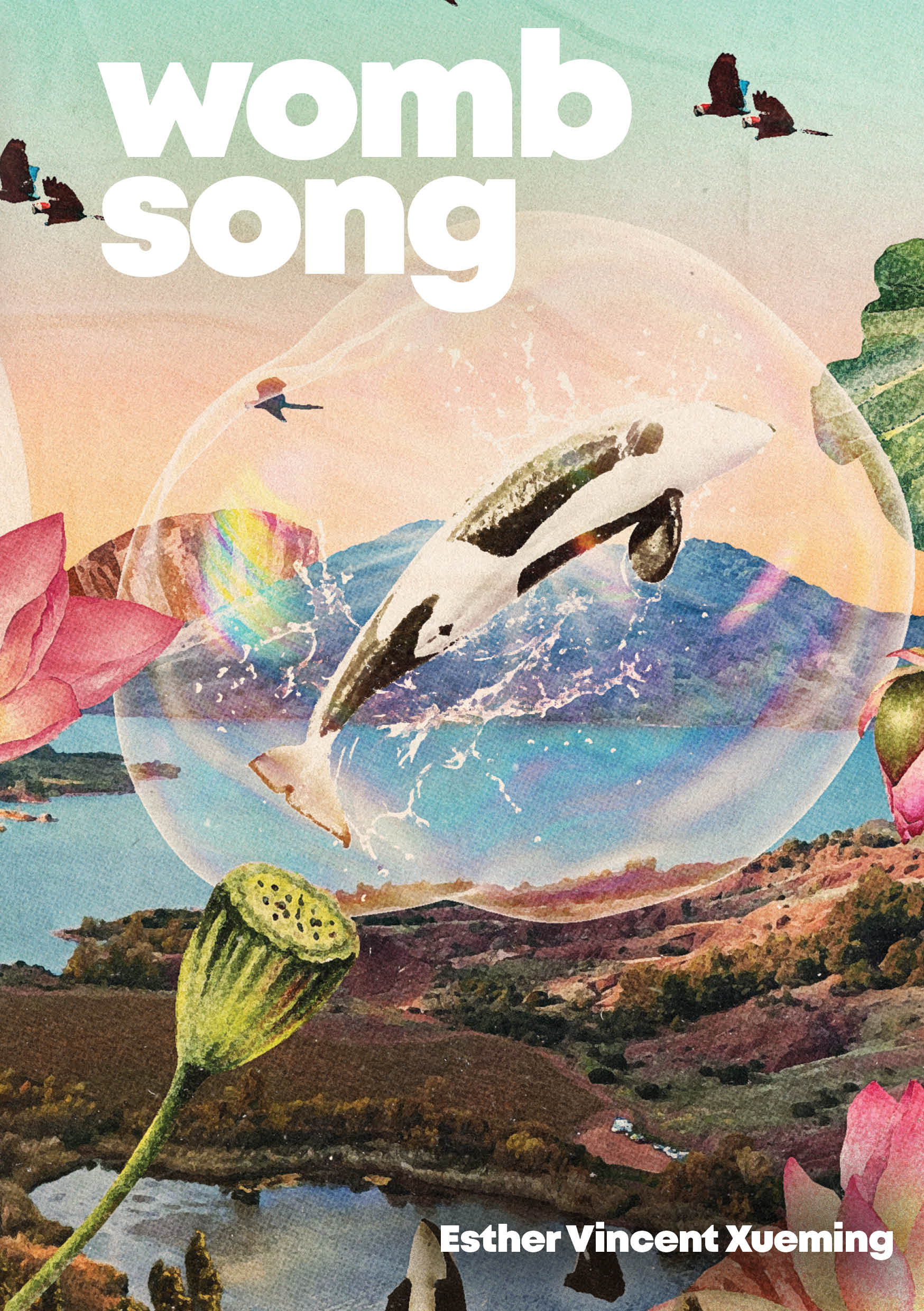
womb song
- Description
- Praise
- About the Author
-
“Now you are gone and for a while my womb lost its voice and forgot how to sing. / What is a song but a daughter’s love transcending time and space? / I am learning to listen.”
When her beloved dog Ealga dies, Esther Vincent Xueming finds her home, which had been filled with the songs and sounds of Ealga’s life, abruptly silent. womb song chronicles Esther’s journey through grief as she wanders from landscape to landscape, from a temple in Bangkok to her subconscious, from the Kinabatangan River to the uncharted space of her dreams. All the while, the sea within her tosses. As Esther searches for healing, she finds herself asking, what does it mean to mother—a dog, a child, another non-human life—and be mothered?
A new nature poetry collection that revolves around the relationship between humans and non-humans. Great for readers interested in spirituality and self-discovery as well as readers who are new to poetry.
-
“In womb song, an elegy for non-human kin opens up the heart in wild tenderness. Esther Vincent Xueming invites us into delicate, vulnerable interiorities of musical paeans to fauna and flora— elephant to heron, canine to bee, fern to bamboo—and lush dreamscapes. Here, grieving is a transformative process, revealing new worlds through song-meditations on the gentle creatures around us. ‘earth womb / mother womb / light womb’, a complex maternal love is wrestled with throughout these poems. In her menagerie of dreams and dream-creatures, grief and kinship bring us to ’the water over a jellyfish sea, our laughter glowing and luminescent in the daylight thrill’. The poet teaches us of emotional dimension: ‘there can be no grief in the presence of infinite love.’”
—Khairani Barokka, author of amuk“Esther Vincent Xueming, an acclaimed ecopoet, focuses her attention on multispecies relations and kinships. Through dreams and songs, prose and lyric, she crafts a profound meditation on mothering, loss, grieving, and letting go. This book is, indeed, a “womb song to the world.” May it echo across our wounded planet.”
—Craig Santos Perez, author of Habitat Threshold“womb song is an incredible, profound and transformative collection of poetry. Esther Vincent Xueming takes the reader on a surreal journey of interconnectedness between the realms of life and afterlife, joy and grief, dream and reality, consciousness and subconsciousness and the seemingly invisible but ever present living organisms that are affected by each step we take on this earth. Deeply felt is our interbeing and humanness merging with plant, animal, water relatives. Vincent writes, “Teach me, fern, to shed my brown leaves and grow again with little resistance,” and “In another dream, small white flowers bloom from my fingers and I reach out to offer them to a hummingbird.” Like the mother orca calling to her lost baby, Esther Vincent Xueming’s womb song calls us back home with her song. Perhaps, our heart is indeed “just a lotus waiting to bloom.” To experience Vincent’s lucid dream world is to breathe underwater.”
—Teresa Mei Chuc, author of Red Thread (Fithian Press, 2012), Keeper of the Winds (FootHills Publishing, 2014) and Invisible Light (Many Voices Press, 2018)“womb song sings the “I” through the hard places of grief, and through the flow of loss that becomes a river-path back to life. The wombs in Esther Vincent Xueming’s second collection are both human and more-than-human; by turns deliberately barren, or in quest of lost offspring, and sometimes mothers in search of their own mothers. Consisting of dreamscapes and open-form verse, the collection invites readers on a journey where orcas, dogs, stars and elephants journey alongside a tender discovery of the capacity to love and hurt.”
—Ann Ang“womb song pays tribute to the extraordinary bond between the poet and her more-than-human kin Ealga. Passing through grief, the poet’s heart and consciousness open up to her connections to the various sentient beings she encounters. Some poems function like incantatory songs, either knotted into arguments with loss or marvelling at unexpected moments of companionship. The dream sequences in the second half of the book are rich with the collision of images, supplanting ego-driven logic of the conscious mind with complex visual codes from the unconscious terrain of dream logic.”
—Lydia Kwa, author of A Dream Wants Waking -
Esther Vincent Xueming is the editor-in-chief and founder of The Tiger Moth Review, an independent eco journal of art and literature based in Singapore. She is the author of two poetry collections: womb song (2024) and Red Earth (2021), and co-editor of two environmental anthologies: Here was Once the Sea: An Anthology of Southeast Asian Ecowriting (2023) and Making Kin: Ecofeminist Essays from Singapore (2021). She co-edited Poetry Moves (2020) and Little Things (2013), two poetry anthologies that are widely used in secondary schools nationwide. Esther has served as guest editor for Mānoa Journal (35.2), University of Hawai’i Press (2024) and as guest regional editor, Asia for a special eco-themed issue of The Global South (16.1), University of Mississippi (2023). Her essays have been published in The Trumpeter, EcoTheo Review, Sinking City Review and Quarterly Literary Review Singapore. A literature educator by profession, she is passionate about the entanglements in art, science, literature, spirituality and ecology.
Product Information
Product Information
Shipping & Returns
Shipping & Returns
Description
- Description
- Praise
- About the Author
-
“Now you are gone and for a while my womb lost its voice and forgot how to sing. / What is a song but a daughter’s love transcending time and space? / I am learning to listen.”
When her beloved dog Ealga dies, Esther Vincent Xueming finds her home, which had been filled with the songs and sounds of Ealga’s life, abruptly silent. womb song chronicles Esther’s journey through grief as she wanders from landscape to landscape, from a temple in Bangkok to her subconscious, from the Kinabatangan River to the uncharted space of her dreams. All the while, the sea within her tosses. As Esther searches for healing, she finds herself asking, what does it mean to mother—a dog, a child, another non-human life—and be mothered?
A new nature poetry collection that revolves around the relationship between humans and non-humans. Great for readers interested in spirituality and self-discovery as well as readers who are new to poetry.
-
“In womb song, an elegy for non-human kin opens up the heart in wild tenderness. Esther Vincent Xueming invites us into delicate, vulnerable interiorities of musical paeans to fauna and flora— elephant to heron, canine to bee, fern to bamboo—and lush dreamscapes. Here, grieving is a transformative process, revealing new worlds through song-meditations on the gentle creatures around us. ‘earth womb / mother womb / light womb’, a complex maternal love is wrestled with throughout these poems. In her menagerie of dreams and dream-creatures, grief and kinship bring us to ’the water over a jellyfish sea, our laughter glowing and luminescent in the daylight thrill’. The poet teaches us of emotional dimension: ‘there can be no grief in the presence of infinite love.’”
—Khairani Barokka, author of amuk“Esther Vincent Xueming, an acclaimed ecopoet, focuses her attention on multispecies relations and kinships. Through dreams and songs, prose and lyric, she crafts a profound meditation on mothering, loss, grieving, and letting go. This book is, indeed, a “womb song to the world.” May it echo across our wounded planet.”
—Craig Santos Perez, author of Habitat Threshold“womb song is an incredible, profound and transformative collection of poetry. Esther Vincent Xueming takes the reader on a surreal journey of interconnectedness between the realms of life and afterlife, joy and grief, dream and reality, consciousness and subconsciousness and the seemingly invisible but ever present living organisms that are affected by each step we take on this earth. Deeply felt is our interbeing and humanness merging with plant, animal, water relatives. Vincent writes, “Teach me, fern, to shed my brown leaves and grow again with little resistance,” and “In another dream, small white flowers bloom from my fingers and I reach out to offer them to a hummingbird.” Like the mother orca calling to her lost baby, Esther Vincent Xueming’s womb song calls us back home with her song. Perhaps, our heart is indeed “just a lotus waiting to bloom.” To experience Vincent’s lucid dream world is to breathe underwater.”
—Teresa Mei Chuc, author of Red Thread (Fithian Press, 2012), Keeper of the Winds (FootHills Publishing, 2014) and Invisible Light (Many Voices Press, 2018)“womb song sings the “I” through the hard places of grief, and through the flow of loss that becomes a river-path back to life. The wombs in Esther Vincent Xueming’s second collection are both human and more-than-human; by turns deliberately barren, or in quest of lost offspring, and sometimes mothers in search of their own mothers. Consisting of dreamscapes and open-form verse, the collection invites readers on a journey where orcas, dogs, stars and elephants journey alongside a tender discovery of the capacity to love and hurt.”
—Ann Ang“womb song pays tribute to the extraordinary bond between the poet and her more-than-human kin Ealga. Passing through grief, the poet’s heart and consciousness open up to her connections to the various sentient beings she encounters. Some poems function like incantatory songs, either knotted into arguments with loss or marvelling at unexpected moments of companionship. The dream sequences in the second half of the book are rich with the collision of images, supplanting ego-driven logic of the conscious mind with complex visual codes from the unconscious terrain of dream logic.”
—Lydia Kwa, author of A Dream Wants Waking -
Esther Vincent Xueming is the editor-in-chief and founder of The Tiger Moth Review, an independent eco journal of art and literature based in Singapore. She is the author of two poetry collections: womb song (2024) and Red Earth (2021), and co-editor of two environmental anthologies: Here was Once the Sea: An Anthology of Southeast Asian Ecowriting (2023) and Making Kin: Ecofeminist Essays from Singapore (2021). She co-edited Poetry Moves (2020) and Little Things (2013), two poetry anthologies that are widely used in secondary schools nationwide. Esther has served as guest editor for Mānoa Journal (35.2), University of Hawai’i Press (2024) and as guest regional editor, Asia for a special eco-themed issue of The Global South (16.1), University of Mississippi (2023). Her essays have been published in The Trumpeter, EcoTheo Review, Sinking City Review and Quarterly Literary Review Singapore. A literature educator by profession, she is passionate about the entanglements in art, science, literature, spirituality and ecology.